“We still have to eat”
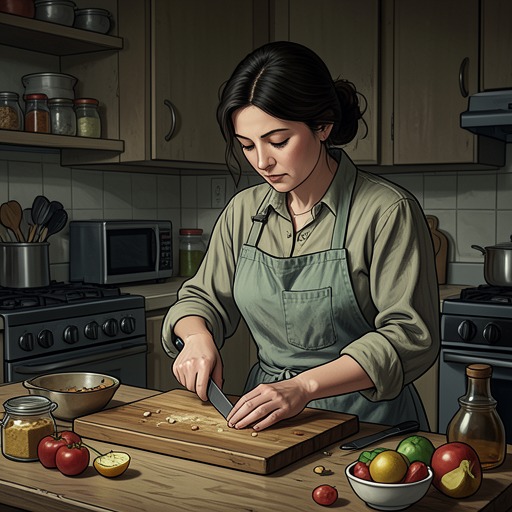
All My Puny Sorrows“We still have to eat” is an expression of ordinary survival spoken against extraordinary loss. Its force lies in the distance between grief’s immense claims and the body’s unrelenting needs: after a death, there is still a meal to arrange; amid a family crisis, care still requires money, time, and practical decisions.
The phrase after a death
After Yolandi and Elfrieda Von Riesen’s father dies beside the railway tracks, the police return his belongings to the family. His glasses crumble in Lottie’s hands; his watch is broken, and his wedding rings are battered. The account dwells on damaged objects and broken bones, then turns to what remains usable: he had seventy-seven dollars on him. The family spends it on Thai takeout, following Julie’s reminder about times like this: “You still have to eat.”
The meal does not undo the death or make the money signify anything like compensation. Instead, the modest act of using it for food places immediate need beside the violence of the loss. Julie’s wording is slightly different from the expression’s canonical form, “We still have to eat,” but carries its same unsentimental insistence: grief does not suspend the requirements of living.
Care as practical work
That insistence resonates with the later effort to organize care for Elfrieda Von Riesen after her hospitalization. Nic plans to visit her after work, and he and Yolandi are trying to assemble a team of caregivers for her possible release. Elfrieda resists the language of a “team,” hearing in it a program of lists, goals, journals, and prescribed fun rather than a convincing response to her distress. The disagreement exposes a divide between the practical need to sustain care and Elfrieda’s distrust of the reassuring language used to organize it.
The plan is also materially uncertain. When Yolandi asks Nic about the team, he explains that budget cuts and policy changes make it more mythical than real. He has arranged for Margaret to stay with Elfrieda for a few hours each day, while Lottie will visit daily. Elfrieda is supposedly due to begin a five-city tour in two weeks, but Yolandi questions whether she is well enough to tour and asks whether Nic has spoken with Claudio. The hoped-for structure of care has to contend with limited resources, family availability, and an unsettled future.
Money, survival, and what can be provided
The phrase’s plain material emphasis also speaks to Yolandi’s later attempt to find a way to take Elfrieda to Zurich. She asks a bank for a $20,000 loan to cover travel, treatment, a hotel, and even cremation and an urn. She offers her Rodeo Rhonda books as evidence of a possible future advance, but the banker requires collateral or a book contract; she has neither. Elfrieda’s money is in a joint account with Nic, and Yolandi worries he would notice a large withdrawal. An imagined alternative—Yolandi accidentally calls her unfinished book a boat—briefly enters the conversation, while Nic agrees that Elfrieda could come to Toronto if she wanted.
The family’s resources are unequal as well as limited. Yolandi describes herself and Sheila among the “Poor Cousin contingent,” while male descendants in the wealthy branch inherit the family business and pass its wealth to their sons. The women’s lack of inheritance sits beside the ordinary costs of feeding and raising children, paying for university, and maintaining a home. Against that background, eating is not merely a comforting symbol; it belongs to the concrete economy of who can provide, and with what.
A continuing obligation
After Elfrieda’s death, her bequest gives Yolandi life-insurance money and a monthly sum of $2,000 for two years so she can stay home and write. Elfrieda leaves money for the children’s trust funds and for Lottie’s travel, hearing aids, and a new car; the remainder goes to Nic. Yolandi plans to use the insurance money to buy a dilapidated fixer-upper in Toronto, and Lottie moves there to live with her and Nora.
The later provision of money does not turn the family’s earlier losses into a resolved account. It does, however, make visible the work that survival requires: food, housing, care, and enough security to make a life or continue writing. Across the family story, “We still have to eat” holds together the irreducible everyday and the events that threaten to overwhelm it.